Monday, April 30, 2007

The Irony Of Athenian Women


Throughout mankind’s existence on earth we have always depended on women in one way or another. Whether this notion is represented as a mother figure, a daughter, a peace bearer or an affectionate lover, women have always been essential to the survival of human civilization. Even though the Athenians thought women were inferior to men they still recognized this necessity about women and celebrated them by acclaiming a young girl of a very prominent background as the hope of a whole nation.

So with this undoubted appraisal of women what exactly is the irony of the Athenian women? Well the irony starts off by how women were viewed by the males of Athenian society. The views of the people in charge of Athens were that women were entitled to be a threat to human civilization with violence and promiscuity. These claims however were really not based on any factual evidence. They were only based on the struggle for men to hold all the power in society. How this affected women though was that it treated them to a life of luxury. Like people of our day and age with mental conditions, women lived above the law. If there was a case of adultery in Athenian society it was not the woman’s fault. They treated an act of adultery as the male’s fault. Society would just give the woman that was involved in the incident the benefit of the doubt because they were seen as not as intelligent as men and were more prone to promiscuice behavior. This were we start to unfold the irony Athenian women. Women in Athenian society lived far more secure and enjoyable lives due to their necessity in the world. Even though they were looked at as inferior they enjoyed a life of security over a life of freedom. They were of course handed this life of security on a silver platter because an Athenian male without a wife was not taken seriously by society.

What I thought was interesting about this notion of a lack freedom in exchange for security is that there is still remnants of this ideology in our own society. Think of the reasons a women decides to marry someone; sometimes it’s out of true love sometimes it is out of sexual pleasure and sometimes it’s even for intellectual stimulization but sadly a lot of the time it is for the ability to go max out a husbands credit card on 5th Avenue in New York. So why do men after thousands of year fail to realize this? It is do to the simple fact that through having a wife they feel less ostersized by society. History is just a story that repeats itself and through classical literature we have the ability to understand the eternities and realize that what is going on now is a story that has already been told.

Sunday, April 29, 2007


When I think of the story of Daedalus and Icarus my pleasant mood plummets faster than the actual fall of Icarus. What I found to be the most important allegory in this story was Daedalus’s wings. The reason I found his wings to be the most important out of these allegorical things was the pain of an artist represented through his work. An artist a lot of the time can be interpreted as a tortured soul. In Daedalus’s artistry we see directly how his passionate mastery consequently causes him to be a tortured soul. I actually had to read a poem for my English 123 class about a poet’s depiction of the Deadalus and Icarus story by W. H. Auden entitled “Musee des Beaux Arts”. He begins the poem by saying “About suffering they were never wrong. The Old Masters: how well they understood it’s human position”, he really believes this is a story of suffering and nothing less. This story of suffering fulfills him in a way; it is a story that has remained fresh for almost two thousand years.

What do we derive from this suffering though? Possibly one point that Ovid’s trying to make is that suffering as an artist comes from trying to rival the god’s skills. We certainly see this represented in the story of Archane and Minerva, is not possible this is a component of the story Daedalus and Icarus. The suffering in both these stories from “The Metamorphoses” adds to the redemptive power of art. So perhaps suffering is essential to art and the more suffered an artist the more redemptive the art.

Passage of Time


In Ovid’s metamorphoses I feel that the strongest statement to describe the overall message of the book comes from Pythagoras. He says on page 520 “for all things flow; all things are born to change their shapes. And time itself is a river, on an endless course. I am pretty sure that people chose this as their favorite lines of the book for class discussion so I am not going to really dig into this quote to much, I just thought it would explain some of what I am going to talk about. What I want to talk about is Pythagoras’s idea of comparing a lifecycle to seasonal changes. I thought this was one of the most interesting concepts from the book because I have never really thought about a life from death to birth compared to spring, summer, fall and winter. When I first read this idea I really didn’t think about it too much because I was hung up on Pythagoras’s other philosophies on life. Reading over this again it started to make sense to me as one of the most truthful notions about life and the earth that I have ever read.

For me my philosophy on life is agreeable to Pythagoras’s; so when he talks about the earth being alive and bodies becoming other bodies it is almost like reading a factual text. Pythagoras describes the earth like a mother; a mother that gives life to all it’s creatures. It is through his description of springtime where we start to understand this as a truthful statement about mother earth. Spring is the season of newly born's and the first stage of life; like a womb the earth in the season of spring provides a budding seed with the sustenance to maintain life and let it grow. This season represents the first season of a child; it is the season of life where it is allowed to grow and be comforted by it’s mother. Summertime is the season of power in a human’s life. It is the season of strength and beauty. No longer needing the help of mother this is the season where young people are forced to decide for themselves and choose their own path in life. This is the most defining season in a human’s life. The season after summer is, as we all know autumn. This is the season in between youth and age it is also the season of mildness. For us it is the season of the dreaded middle aged. This is the season where we watch are hair like falling leaves disappear from our once beautiful head. We should not dread any of the seasons though; each serves as a purpose life. The season of autumn is where we can still be what we once were but in a relaxed way. As autumn transcends into winter we finally come to old age. Old age is a time of wisdom but also a time of death what once were green robust leaves are now dead or white. This season seems like a time of hopelessness. What were once young vibrant people are now just relics of what they once were. This though is not a depressing time. We have to remember old age is just a period of time before metamorphoses. The quote I choose at the beginning of the blog I feel is a beautiful representation of the notion of bodies becoming other bodies. We should not fear death, because in all its feared blackness a sun will rise on a beautiful spring day

Tuesday, April 24, 2007

5 conflicts of Antigony depicted through Holden Caulfield


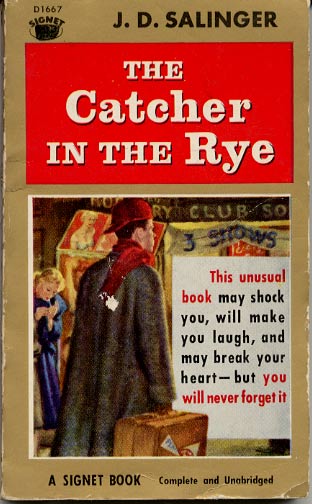
I would like to pick up some other elements of classical literature I found in this novel. Catcher in The Rye is essentially a tragedy until the end of the book when Holden finds himself. And with this eerie sense of tragedy foreshadowing the book I was able to pick up the five main conflicts of Antigony in Holden Caulfield’s life. First man against society, this is completely apparent throughout the whole novel. Holden Caulfield absolutely despises anything that he see’s that meets societal conformity. Or at least he appears that way he is secretly denying his desire to fit in. This is why his final outcome is ironic, he is happy and he is seeking professional help in the Mecca of phonies Hollywood. Living and the dead is a little more of a deep-rooted conflict in Holden’s life. It has been affecting him in a strange way ever since his younger brothers death. Holden feels very corrupted by the absence of his younger brother because in a sense he feels like it his fault and that it his duty to protect children from the evil world. But since this hole in his heart has affected him for such a long time he becomes semi suicidal and even dead on the inside alienated from the living until the catcher of course is caught. Another very apparent conflict is young and old. Holden’s original philosophy is that young people are the ultimate virtue in life and that the adult world is plagued with to many evils to even give up one’s youth. This to me is Holden’s main conflict in life. Holden’s man and women conflict actually only really occurs on one occasion in this book. It’s between him and his summer hook up Sally Hayes. She represents to Holden the queen of phonies but through his ironic man and society conflict he loves her at the same time. The man and women conflict creates a raging madness to it’s own extent but when you add all of Holden’s other lunatic qualities you have a recipe for disaster. Holden is in and out of love with this girl in every sentence he speaks with her. She likes him too but not with such a peak, pitfall contrast like Holden. And finally we come to Holden’s perspective of men and the gods. Holden has lost faith or he just has not had time for it. He doesn’t feel he has anything to give grace to and his family was never really that religious. His conflict is that he has not found anything to suggest the presence of god until the end of the novel after all the hell he has gone through. This only occurs after he gets a glimpse of faith through his sister and her love. It seems that through something as wonderful as his sister this story turns from tragedy to redemption. Holden Caulfield’s metamorphoses is in a simplistic statement is “hey there is something better than hating the world for it’s evils and that is loving the world and man kind for what it is”

P.S i chose this pic for the concept of metamorphosis

Summary of friday essay


I have been meaning to write this blog for a while now along with many others so anyway here it goes. After reading J.D Salinger’s novel Catcher in The Rye and some modern interpretations on this particular book I have decided to talk about Holden Caulfield’s metamorphoses through the symbolic structure of the book. I am going to write my final paper on this so this is more of just a quick blog to get my thoughts down.
Holden Caulfield’s character to me is one of the most brilliant depictions of what humanity is. He is nihilistic, existentialist, idealistic, and even in a sense completely false. At the same time he holds his idealistic sense of humanity higher than the rest of his traits; we see this represented through his sister phoebe. His character is so complete that it causes a metamorphosis from beginning to the end. One of the main symbolic images of this novel is Holden’s desire to literally be the catcher in the rye. Which essentially means saving childhood from the evil adult world. Holden comes up with this concept through a poem that Phoebe and him have enjoyed over the years. The lyric that is the essence of Holden’s philosophy is “if a body catch a body”.
Now here is the ironic part about this concept of being the catcher in the rye; that lyric that Holden held so high up is actually wrong. The correct lyric turns out to be “If a body meet a body”. And through his failed attempts at his concept of an ideal life he starts to recognize this irony. He does not get upset though, he looks to his sister to understand this “if a body meet a body” concept. What he realizes through all his struggling in out of ideal states of being is that you have to love the world and man for what it is. There is no point in trying to save it form evil just let the individual find out what it is for themselves. The pitfall through adolescence and into adulthood is what defines a human being so let man meet man but with love. This is the essential metaphor of the book and it is realized through Holden’s Metamorphoses through the brute underworld of New York City.

Monday, April 2, 2007


The Journey

I lost my mind on a mountaintop
Looking up in down I knew it would not stop
Opening my eyelid
I saw where heaven and hell divided

Complete insanity had rushed in
I new I belonged in a godamn Looney bin
It waved and waved
But hell, this fellow was not going to be saved

I heard a flute quietly playing
Just then I knew exactly what Dionysos was saying
He spoke to me while I was stroking the sky
And said young mortal what are you going to do before you die

Letting loose all the conceptions of life I once had
They stampeded across the mountain; I was not at all said
Reborn in the mountain
I looked to the woods to find my fountain

In the darkness of the trees
My soul was burning like a spreading disease
Until, I stumbled into a fair forest muse, I asked what her purpose was?
She looked into my eyes and said young mortal to help you find what you are looking for that’s what a muse does

Walking through the enchanted forest
My heart started to sing of metamorphoses
Right and left my mind started setting
I knew what my purpose was it was the earth that I needed to stop neglecting

From mountain top to forest my journey was complete
I know longer lived a life of greed and deceit

Friday, March 30, 2007


The Metamorphoses of youth


For the assignment that was given last Wednesday I choose lines from the story of Arachne. My quote from this story is “Not all that old age offers is mere chaff: for one, the years bestow experience. Take my advice: it is enough to be supreme among all mortals when you weave and work your wool, but never do compete with an immortal goddess. Go, beseech Minerva’s for the words you spoke; ask humbly and she will forgive you”. I choose this quote for a couple of reasons. The first being that it is an attempt to give insight to youth about life and life’s metamorphoses. Second I enjoyed its ironic context. What I mean by this is that it is a great example of youth being arrogant and not seeing what is really going in a particular time and situation. Ovid makes this example by having Arachne badmouth the god while she is directly talking to the god and not even realizing it. This quote carries the story of this young wool weaver by showing that are lives are fragile and there are consequences to pay for excluding modesty in life. Old age is simply the metamorphoses of youth through wisdom and experience. Arachne realizes this later in the story when she shows that her skills do rival the great goddess. Her over confidents blinds her and for this she becomes severely punished. Learning through pain and struggle are the ultimate life lessons which is why I choose this to express the metamorphoses of youth